

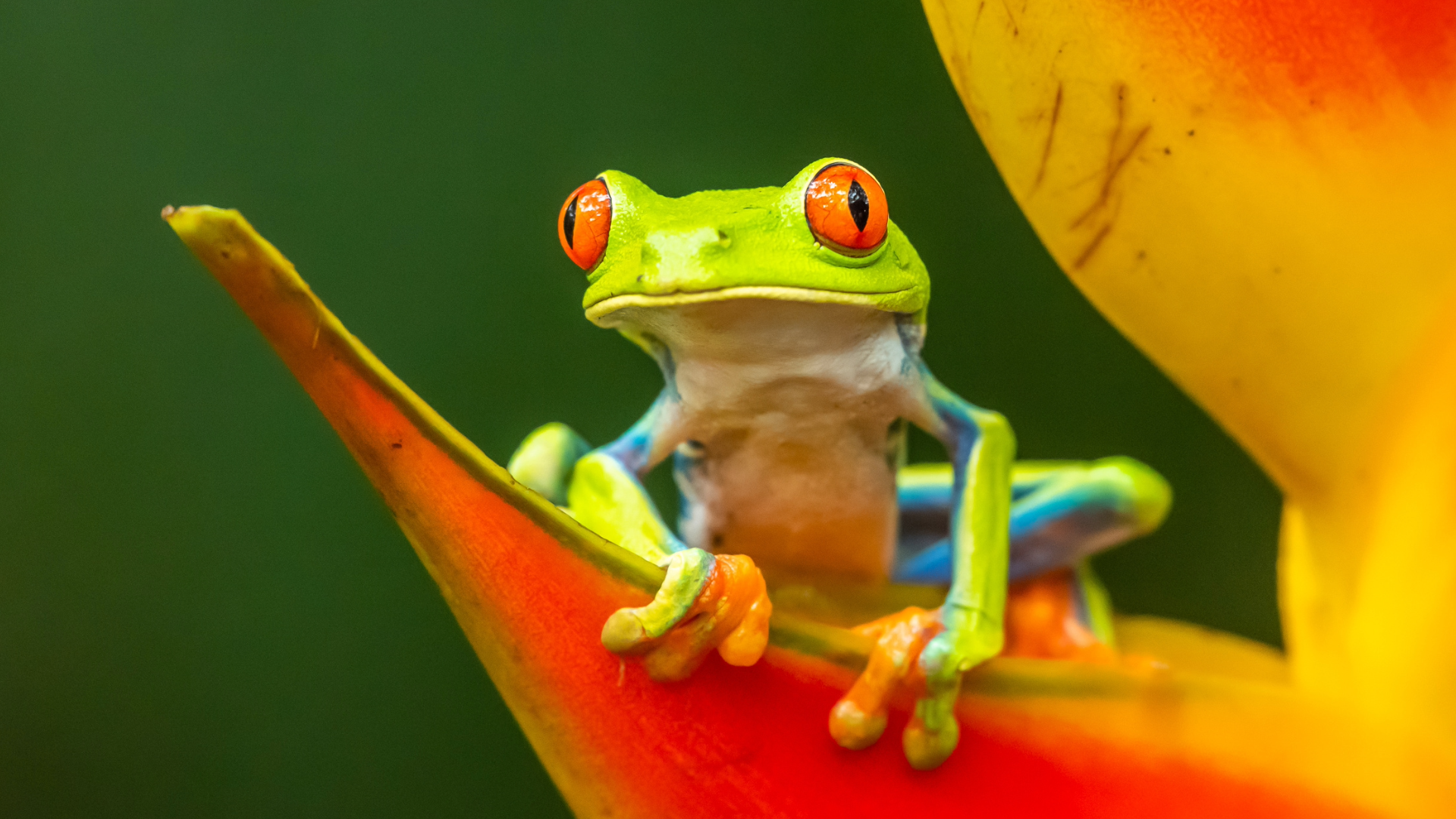
Agalychnis callidryas
Basic Information:
The Red-Eyed Tree Frog is an iconic, vibrant amphibian native to the lowland tropical rainforests of Central America, extending from southern Mexico down through Panama and into northern Colombia. Famous for its flash coloration, this frog features a vivid lime-green dorsal body accented by cobalt-blue and yellow-striped flanks, bright orange or red webbed feet, and oversized scarlet eyes with vertical pupils. Adults are relatively slender and moderate in size, with females reaching roughly 2.5 to 3 inches in length and males remaining smaller at about 2 inches.
These frogs are strictly nocturnal, spending daylight hours flattened asleep underneath broad leaves with their limbs tucked in and eyes closed, blending seamlessly into foliage. When disturbed, they snap open their massive red eyes and reveal their vivid flanks and feet in a startle display designed to confuse predators. They are arboreal, spending nearly their entire lives off the ground, and are well suited to thriving in humid, planted naturalistic vivariums.
Lifespan:
8–12 years in captivity with proper care.
Sexing:
Mature females are visibly larger and stockier than males. Sexually mature males develop dark, rough nuptial pads on the inner base of their thumbs used for gripping females during amplexus (mating), and they will produce short, repetitive "chack" vocalizations at night.
Enclosure:
Juveniles: A 10-gallon vertical conversion terrarium or 12x12x18-inch front-opening glass terrarium.
Adults (Pair or Trio): Minimum enclosure size of 18x18x24 inches (or larger), with vertical height prioritized. Provide abundant broad-leafed live or artificial foliage (such as Pothos, Monstera, and Philodendron), vertical climbing branches, bamboo poles, and cork bark tubes. A screen top is necessary to ensure adequate ventilation and prevent stagnant air.
Substrate:
A bioactive tropical substrate layer consisting of coconut fiber, ABG mix, or organic topsoil over a drainage layer (hydroton clay balls separated by mesh screening). Cover the substrate completely with a dense layer of magnolia or oak leaf litter and live moss to prevent frogs from ingesting loose dirt particles when striking prey.
Lighting & Temperature:
Basking Spot: 82°F–84°F (A very gentle, low-wattage basking or ceramic heat element can be placed on one side of the upper canopy; never allow temperatures to exceed 85°F).
Ambient Temperature: 75°F–80°F
Cool Side: 72°F–75°F (Nighttime temperatures can safely drop to 68°F–72°F).
Lighting & UVB: Provide low-output 2.0 to 5.0 (or shade-dweller) linear UVB lighting along with a 6500K plant LED on a 12-hour day/night cycle to support biological rhythms, vitamin D3 synthesis, and live plant growth.
Humidity:
60%–70% during the daytime, spiking to 80%–100% at night. Mist thoroughly in the evening and lightly in the morning using dechlorinated, reverse osmosis, or distilled water. High humidity must be paired with steady airflow to prevent bacterial and fungal skin infections.
Food:
Strictly Carnivorous (Insectivorous). Feed gut-loaded live insects dusted with high-quality reptile supplements:
Juveniles: 1/4-inch crickets and small fruit flies (Drosophila hydei) fed every 1–2 days.
Adults: 1/2-inch to 3/4-inch banded crickets, small dubia roaches, black soldier fly larvae, and occasional waxworms or hornworms fed every 2–3 days (around 3–5 insects per frog). Dust feeders with calcium containing D3 at most feedings, and a high-potency amphibian multivitamin (especially vitamin A) once Monthly..
Water:
Provide a wide, shallow, clean water dish that allows frogs to easily soak their lower abdomen to hydrate via their "seat patch." Amphibians absorb water directly through their skin, so water must always be treated with an aquarium water conditioner or dechlorinator. Change the water dish daily, as frogs frequently defecate in water.
Red-Eyed Tree Frogs are the quintessential jewels of the rainforest. Their striking neon colors, nocturnal foraging behavior, and peaceful communal nature make them the ultimate showcase species for lush, planted tropical bio-active vivariums.
Where Can I get a red-eyed tree frog near me?
If you're in Gaithersburg, Maryland, visit Critters, Reptiles & Exotics in Frederick to check availability of Red-Eyed Tree Frogs and get expert guidance on bio-active tropical vivarium setups, automatic misting systems, and balanced amphibian nutrition. Whether you're designing your first living terrarium or expanding your exotic amphibian collection, there’s always a new adventure waiting at Critters, Reptiles & Exotics!