

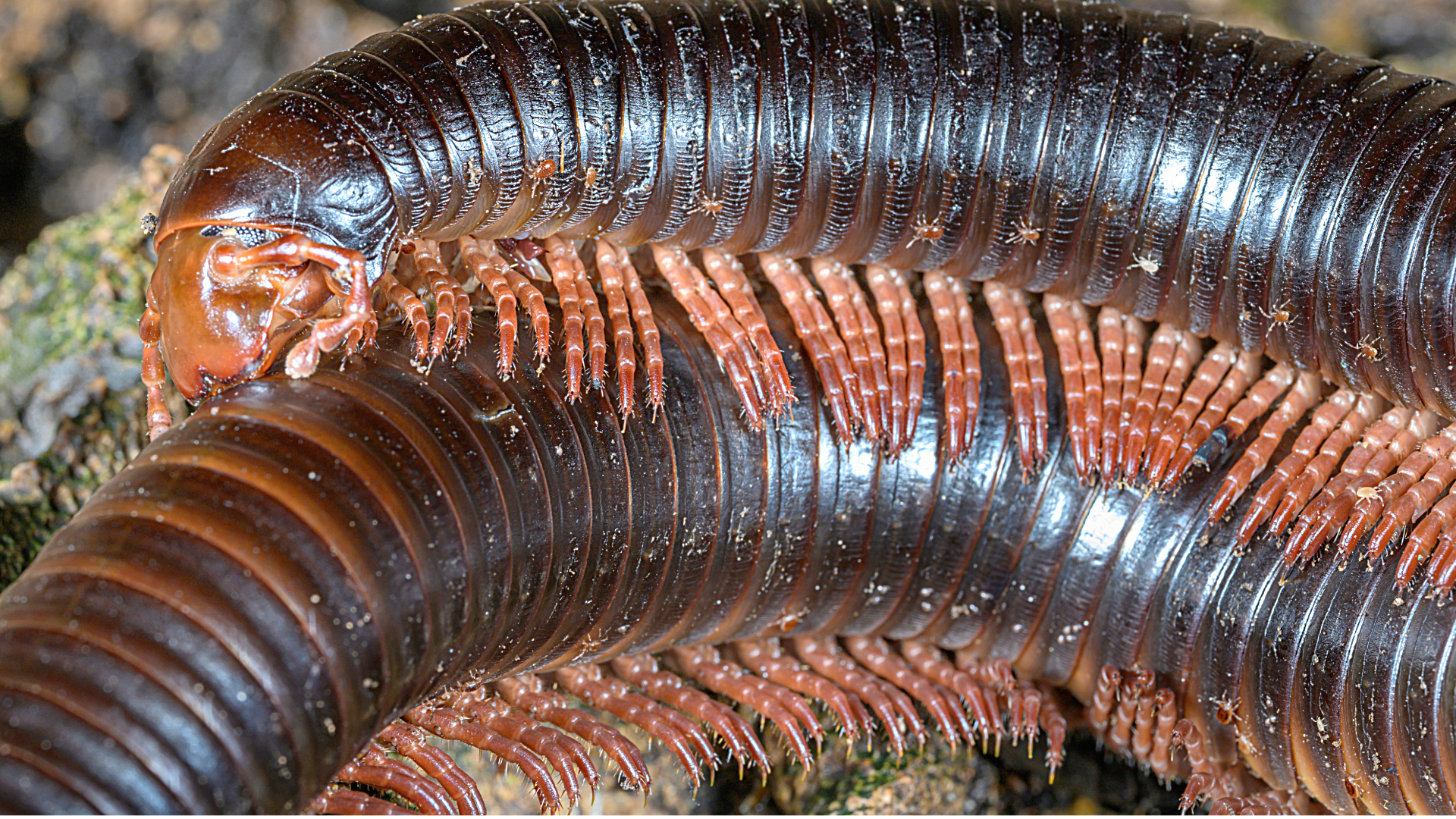
Giant African Millipede
(Archispirostreptus gigas)
Basic Information:
The Giant African Millipede is the largest extant species of millipede on Earth, native to the subtropical rainforests, coastal thickets, and lowland river valleys of East and Southern Africa. Characterized by a glossy, dark brown to jet-black cylindrical body accented by lighter reddish-brown rings and hundreds of synchronized reddish legs, these gentle giants are true titans of the forest floor. Adults typically reach lengths of 8 to 11 inches, with exceptional wild specimens recorded at up to 15 inches and roughly the thickness of a small flashlight.
These detritivores are primarily nocturnal and crepuscular, spending daylight hours coiled beneath rotting logs, buried in leaf litter, or burrowed deep into soil before emerging in the evening to scavenge. When threatened, they roll into a tight defensive coil to protect their soft underside and may secrete an unpalatable, yellow-brown defensive liquid (containing mild quinones) that can stain skin but is completely harmless to humans. Known for their placid disposition and fascinating locomotive waves, they are calm, handleable, and remarkably gentle.
Lifespan:
5 -10 years in captivity
Sexing:
Sexing mature adults is straightforward by examining the legs on the underside of the 7th body segment. Males lack a pair of standard walking legs on this ring; instead, these limbs are modified into specialized reproductive organs called gonopods, leaving an obvious gap or recessed pocket. Females have a continuous, unbroken row of walking legs along the entirety of their underside.
Size:
Up to 8-11 inches (30–38 cm) long
Enclosure:
Juveniles: A 5 to 10-gallon terrarium or ventilated storage tub with adequate burrowing depth.
Adults (Single or Pair): Minimum enclosure size of a standard 20-gallon long (30x12x12 inches) or a 24x18x12-inch front-opening terrarium. The general rule of thumb is that the tank length should be at least double the millipede's body length, and width at least equal to its length. A secure, locking lid with moderate ventilation is essential to hold humidity without allowing air to stagnate.
Substrate:
A deep, specialized invertebrate substrate is the single most critical component of their habitat, serving as both shelter and their primary food source. Provide a 5–8 inch deep layer (at least equal to the total length of the millipede) made of organic topsoil, crushed decaying hardwood (oak, beech, maple), and crushed rotting hardwood leaf litter mixed with a generous amount of calcium carbonate. Avoid plain coconut fiber as a primary substrate (it provides zero nutritional value), and never use cedar, pine, or chemically treated soils.
Lighting & Temperature:
Ambient Temperature: 75°F–82°F (Use a low-wattage side-mounted heating mat regulated by a thermostat if room temperatures drop below 72°F; never place heat mats under the tank, as millipedes burrow downwards to cool off).
Cool Side: 72°F–75°F
Lighting & UVB: No UVB required. Millipedes are naturally photophobic; keep them under standard indirect room lighting on a 12-hour day/night cycle.
Humidity:
75%–85%. The substrate must stay moist throughout its depth—similar to damp potting soil or a wrung-out sponge—without pooling water at the bottom. Mist the enclosure lightly every 1–2 days using dechlorinated water to keep surface moss and leaf litter damp.
Food:
Detritivores/Herbivores. Their primary sustenance comes directly from the decaying wood and leaf litter in their substrate. Supplement their diet 1–2 times per week with:
Fresh Produce: Slices of cucumber, zucchini, squash, sweet potato, melon, banana, and mushrooms (remove uneaten food after 24–48 hours to avoid mold and pests).
Protein: Small pinches of fish flakes, dried shrimp, or insect jelly offered every 1–2 weeks.
Calcium: A constant supply of calcium is vital for building and maintaining their thick exoskeleton. Provide cuttlebone pieces or dust produce with pure calcium carbonate powder at every supplemental feeding.
Water:
Millipedes obtain most of their hydration from their moist substrate, supplemental fresh produce, and mist droplets. However, provide a very shallow ceramic dish with fresh, dechlorinated water; add clean pebbles or a piece of sponge/cork inside the dish to eliminate any risk of accidental drowning.
Handling:
Generally safe to handle gently but avoid stressing the millipede
Wash hands after handling, as millipedes can secrete mild irritants
When threatened, African Giant Millipedes curl into a tight spiral to protect their vulnerable underside, showcasing their armored segments.
Giant African Millipedes are quiet, hypoallergenic, completely harmless, and endlessly fascinating to observe. Their deliberate movements, massive size, and gentle temperament when crawling over hands make them wonderful educational animals and rewarding, low-maintenance exotic pets.
Are Giant African Millipedes available at a Local Pet Store Near Me?
If you're in Frederick County, Maryland, visit Critters, Reptiles & Exotics in Frederick to check availability of Giant African Millipedes and get expert guidance on deep natural hardwood substrate mixes, thermal monitoring, and proper invertebrate care. Whether you're setting up a bioactive woodland terrarium or looking to welcome an iconic gentle giant into your home, there’s always a new adventure waiting at Critters, Reptiles & Exotics!