

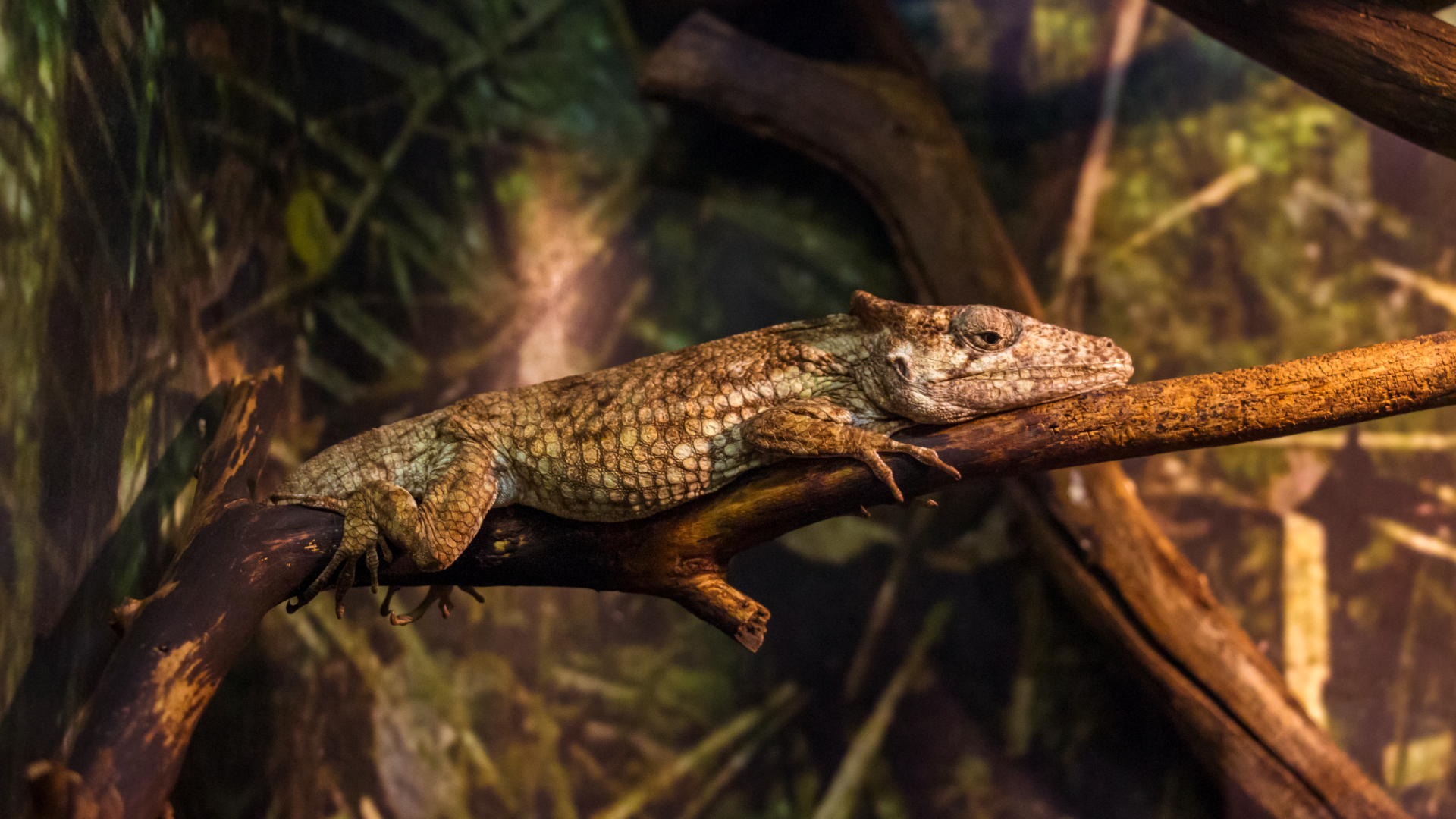
Cuban False Chameleon
(Anolis barbatus)
Basic Information:
The Cuban False Chameleon (often called the Chamaeleolis anole) is a unique, heavy-bodied anole endemic to Cuba. Unlike standard quick, slender anoles, these lizards possess large, blunt heads, independently mobile eyes, and prehensile-tipped tails, giving them an uncanny resemblance to true chameleons. Adults typically reach 10 to 13 inches in total length (with the tail making up roughly half of that length). Known for their calm, slow, deliberate movements and gentle demeanor, they make rewarding and distinct arboreal pets.
Lifespan:
8–15 years in captivity with proper care.
Sexing:
Males: The most reliable external indicator is a pair of distinctly enlarged post-anal (post-cloacal) scales located just behind the vent at the base of the tail, accompanied by a visible hemipenal bulge. Mature males also develop wider heads, stronger jaw musculature, and larger, lighter pinkish/white dewlaps that are displayed during courtship and territorial posturing.
Females: Lack the enlarged post-anal scales and tail bulge. While females also possess a throat dewlap, it is generally smaller and less prominent.
Enclosure:
Enclosure Size: Being strictly arboreal, vertical height is crucial.
Minimum for a single adult: 24” L x 18” W x 36” H (e.g., front-opening arboreal terrarium). Larger setups (such as 36” x 18” x 36” or 4x2x4 ft) are strongly encouraged to accommodate a thermal and UV gradient.
Ventilation: High humidity must be paired with generous ventilation (mesh tops and front or side airflow vents) to prevent stagnant air, which can lead to fungal and respiratory issues.
Decor & Perches: Provide a dense network of horizontal, diagonal, and vertical climbing pathways using sturdy branches, cork bark flats/tubes, and vines. Branches should match or exceed the width of the lizard's body so they can rest comfortably. Live, broad-leaved foliage (such as Ficus, Pothos, Monstera, and Schefflera) provides essential cover, sight breaks, and surfaces for drinking droplets.
Substrate:
A moisture-retentive, organic substrate mix (such as topsoil, peat moss, coconut fiber, and orchid bark) works best. Bioactive setups seeded with springtails and isopods are ideal for processing organic waste and maintaining natural humidity levels.
Lighting and Temperature:
Basking Spot: 85°F–88°F (avoid temperatures exceeding 90°F to prevent thermal stress). Provide heat using an overhead incandescent flood bulb or halogen lamp regulated by a dimming thermostat.
Ambient Temperature: 75°F–82°F throughout the middle and upper canopy.
Nighttime Drop: 68°F–74°F (night heating is generally unnecessary unless room temperatures dip below 65°F).
UVB Lighting: Linear T5-HO bulbs are required. Compact or screw-in coil UVB bulbs do not provide an adequate or consistent UV footprint.
Use a T5 High Output 5.0 / 6% Forest UVB tube mounted in a reflector fixture across roughly half to two-thirds of the enclosure roof.
Aim for a UV Index (UVI) of 1.5 to 3.0 (Ferguson Zone 2–3) at the primary basking perch, ensuring appropriate distance from the mesh screen.
Humidity:
Humidity Levels: 60%–80%. Humidity can spike into the 80s during morning and evening mistings, then dry down to around 55%–65% during peak midday basking hours.
Hydration: False chameleons rarely drink standing water from bowls. They rely almost exclusively on lap-drinking water droplets from leaves and branches:
Mist heavily 1–2 times per day using an automated misting system or hand pressure sprayer.
A continuous slow-dripper directed over broad leaves is highly recommended to encourage hydration throughout the day.
Food:
In nature, Anolis barbatus is a specialized molluscivore (durophagous), possessing flattened, molariform teeth built to crush hard-shelled mollusks.
Primary Staple (30%–50% of diet): Captive-bred snails (e.g., Cornu aspersum / garden snails, Helix species, or aquatic mystery/ramshorn/apple snails) and canned reptile snails. Crushing snail shells provides necessary jaw exercise, behavioral enrichment, and a natural source of bioavailable calcium.
Invertebrate Variety: Gut-loaded dubia roaches, discoid roaches, red runner roaches, crickets, and occasional black soldier fly larvae (BSFL).
Treats (Sparingly): Hornworms, silkworms, or waxworms.
Water:
They rarely drink from bowls, so misting to provide water droplets on leaves is essential. A drip system may also encourage drinking.
Supplementation:
(Crucial: Prevent both Metabolic Bone Disease and Vitamin D3 Toxicity)
Every Feeding: Dust insects lightly with pure calcium without Vitamin D3 (plain calcium carbonate). Note: Snails with complete shells naturally contain calcium and do not require heavy dusting.
Twice per Month (Every 2 Weeks): Dust feeder insects with calcium containing Vitamin D3. Because the animal synthesizes endogenous D3 under linear T5-HO UVB lighting, heavy synthetic D3 supplementation should be avoided.
Once per Month (or every 2–3 weeks): Dust with a high-quality reptile multivitamin powder (preferably with preformed Vitamin A / beta-carotene) to support eye and skin health.
With their unusual appearance, calm nature, and specialized diet, Cuban False Chameleons are one of the most unique anoles in captivity. They are best suited for keepers who enjoy watching natural behaviors in a well-planted, arboreal enclosure rather than frequent handling.
Where can I find Cuban False Chameleons to add to my collection?
If you're in Loudoun County, VA, the Eastern Panhandle of West Virginia, or anywhere nearby, it’s just a quick trip to Frederick, Maryland to visit Critters, Reptiles & Exotics. These fascinating lizards may not be true chameleons, but their slow movements, rotating eyes, and calm nature make them a standout pet. Come check availability, talk care setups, and see why reptile lovers across the region trust us for their next scaly companion. There’s always a new adventure waiting at Critters, Reptiles & Exotics!